
How to Build Resilience in Teens: A Parent's Step-by-Step Guide
Last Updated: October 28, 2026
Quick Summary
To build resilience in teens, help them name the stressor before solving it, practice one small recovery after each setback, and return to routines after a rough week. Resilience is a set of learned skills, not a personality trait, so it grows through small recoveries repeated over time.
- Resilience is not toughness; it is a set of learned skills teens can practice like a sport.
- Ask what the hardest part is, then stay quiet instead of filling silence with solutions.
- After a setback, ask what one thing they would do differently next time.
- Run a four-week plan with one focus per week: awareness, reset, recovery, reach out.
- Seek a therapist if withdrawal from friends and family lasts more than two weeks.
Table of Contents
- What Resilience Means for Teens (and What It Doesn't)
- How to Help Teens Cope with Stress: A Step-by-Step Plan
- Teen Coping Skills That Actually Work Under Pressure
- Resilience Activities for Teens: 7 Options by Age and Interest
- Parenting Strategies for Teen Resilience: Scripts for Hard Conversations
- Digital Stress, Social Media, and Online Peer Pressure
- When to Seek Professional Support: Distress vs. Crisis
- Choosing a Resilience Workbook or Guide for Your Teen
- Frequently Asked Questions
What Resilience Means for Teens (and What It Doesn't)
Knowing how to build resilience in teens starts with the ability to recover from setbacks, adapt to change, and keep going when things get hard. For teens, that means bouncing back after a failed test, a friendship breakup, or a rejection, without falling apart or shutting down.
Here's the part most guides get wrong. Resilience is not toughness. It is not "never crying" or "pushing through alone." Those ideas push teens toward isolation, not strength.
Resilience can be understood as a set of learned skills, not a personality trait. Teens can practice it, the same way they practice a sport. Research on adolescent resilience and mental health shows that supportive relationships and coping skills act as protective factors during adolescence (review of resilience and mental health in children and adolescents).
What resilience does look like:
- Feeling a feeling, then choosing a next step
- Asking for help before things spiral
- Learning from a mistake instead of replaying it
- Returning to routines after a rough week
That is the throughline for everything below: how to build resilience in teens is a practice of small recoveries, repeated.
How to Help Teens Cope with Stress: A Step-by-Step Plan
Teens may benefit from feeling understood before receiving advice. What follows is a four-week structure with sample language and a simple way to track it.

Step 1: Name the Stressor Before Solving It
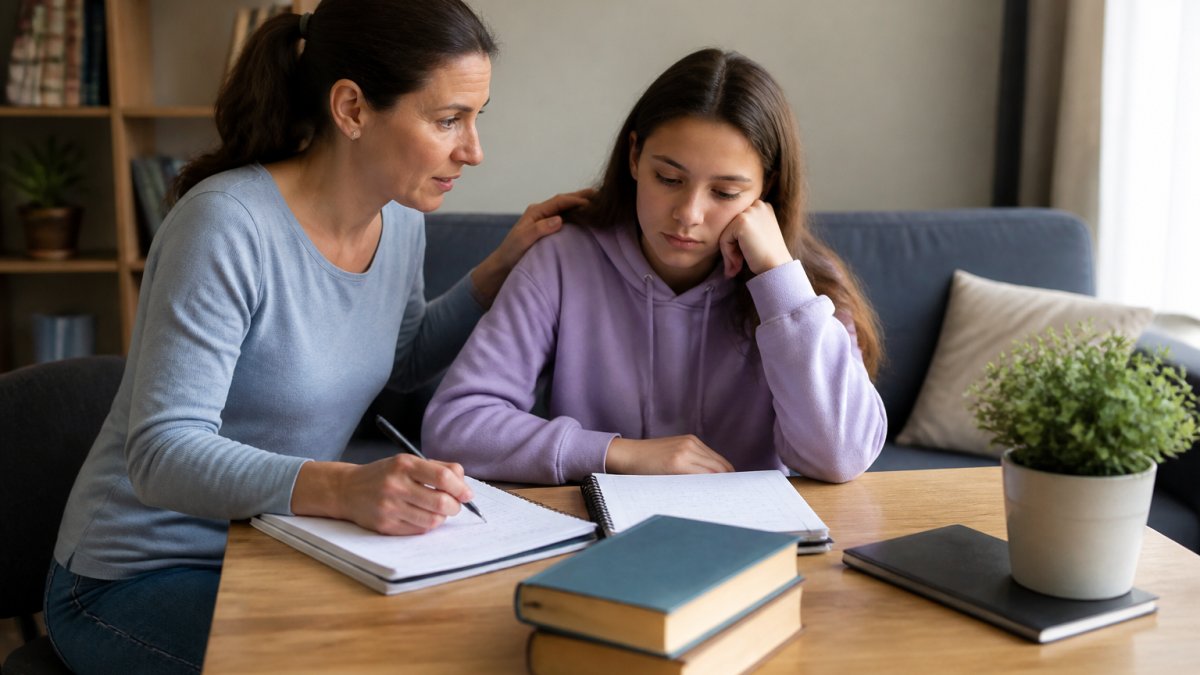
Ask a plain question: "What's the hardest part of this right now?" Then stay quiet. A common mistake is filling the silence with solutions. Putting the problem into their own words helps a teen feel heard and builds emotional awareness, a core coping skill.
Sample scripts to keep in your pocket:
- "That sounds like a lot. What part is weighing on you most?"
- "Do you want help solving it, or do you want me to just listen?"
- "I'm not going anywhere. Take your time."
If your teen shrugs, try a side-by-side setting (car ride, walk, doing dishes) instead of a face-to-face sit-down.
Step 2: Build a Daily Reset Routine
Pick one small habit, such as walking, taking a shower, or listening to music without a phone. The point is consistency, not size.
Step 3: Practice One Small Recovery After Each Setback
After a bad day, ask: "What's one thing you'd do differently next time?" That's it. This turns failure into learning from experience instead of shame. For a deeper walkthrough, our guide on how to help teens manage anxiety covers coping strategies and communication scripts.
Step 4: Run a Four-Week Plan and Track It
Try this simple weekly rhythm:
Week | Focus | What You Do | What to Watch For |
|---|---|---|---|
1 | Awareness | Name one stressor out loud each day | Teen uses feeling words without prompting |
2 | Reset | Pick one daily reset habit and do it five days | Habit happens without a reminder |
3 | Recovery | After each setback, ask the "one thing differently" question | Teen offers a next step instead of shutting down |
4 | Reach out | Teen texts one trusted adult or friend when stressed | Help-seeking happens before things spiral |
Reflection prompts to use at the end of each week:
- What was the hardest moment this week, and what did you do?
- What is one thing you'd do differently next time?
- Who did you lean on, and how did that feel?
Signs it's working: your teen names feelings, returns to routines, and asks for help. The goal is not a teen who never has a bad day.
Teen Coping Skills That Actually Work Under Pressure
Some coping skills are simple, physical, and fast.
- Box breathing: In for four, hold for four, out for four. Repeat four times.
- Name it to tame it: Say the feeling out loud ("I'm frustrated").
- Move the body: Twenty jumping jacks or a lap around the block.
- Write it out: Three sentences in a notes app, no editing.
- Reach out: Text one trusted adult or friend. Help-seeking is a skill, not weakness.
Practice these skills on calm days. For real talk and practical tools on handling big feelings, teens and parents can listen to the podcast Decode Teen Emotions.
Resilience Activities for Teens: 7 Options by Age and Interest
Match an activity to your teen's age and interests. The table below pairs options with developmental stages and skills they may help practice.
Activity | Best Age Range | What It Builds | Why It Fits That Stage |
|---|---|---|---|
Team sport or martial arts | Early teens | Setbacks, coaching, self-regulation | Structure and a coach matter more than autonomy at this age |
Part-time job or volunteering | Middle teens | Problem-solving, confidence | Responsibility and a real role feed motivation |
Music, art, or theater | All ages | Self-discovery, positive outlook | Creative risk-taking is safe practice for failure |
Journaling or a workbook | Middle to late teens | Emotional awareness | Private reflection fits teens who won't talk yet |
Hiking or outdoor challenges | All ages | Adaptability, healthy routines | Physical challenge teaches recovery in real time |
Peer mentoring or tutoring | Late teens | Self-esteem, social connection | Autonomy plus contribution is the late-teen motivator |
Family game nights | All ages | Family support, healthy communication | Low-stakes practice for losing and trying again |
How to Match an Activity to Your Teen
Consider three questions before choosing an activity:
- What does your teen already do without being asked? Build on that. A teen who games for hours may take to a coding club or an esports team faster than to a hiking group.
- Does the activity include a real setback? Resilience needs a challenge with a clear outcome, like a lost match, a failed audition, or a shift that went badly.
- Is there a trusted adult or coach in the room? Supportive relationships are a protective factor, so consider the person as well as the activity.
Follow-Through: The Part Most Lists Skip
Returning to an activity after a hard week can be one way to practice resilience. Consider this:
- Commit to a four-week trial, not a season.
- After each session, ask one question: "What was the hardest part today?"
- If your teen wants to quit, ask: "Is this a bad day or a bad fit?" Give it one more week before deciding.
- Celebrate the return, not the win. "You went back after a rough one. That's the skill."
For teens who prefer working through exercises on their own, Teens Emotional Wellness Workbook pairs coping-skill exercises with reflection prompts that fit the journaling row above.
Parenting Strategies for Teen Resilience: Scripts for Hard Conversations
These scripts give you a starting point for hard conversations.
- When they fail: "That stings. What do you think went wrong?" Not "You should have studied more."
- When they're overwhelmed: "That sounds like a lot. Do you want help solving it, or do you want me to just listen?"
- When they shut down: "I'm here when you're ready. No pressure."
- When they make a mistake: "What did you learn that you didn't know before?"
Active listening means reflecting back what you heard before responding. Validation means saying the feeling makes sense, even when the behavior needs correcting.
Digital Stress, Social Media, and Online Peer Pressure
Social media can expose teens to peer pressure and comparisons between others' posts and their own experiences.
A few guardrails help:
- Charge phones outside the bedroom overnight
- Ask "How did that app make you feel?" instead of banning it
- Follow accounts that teach something, unfollow ones that shrink self-esteem
- Talk openly about comparison, because silence makes it shameful
The goal isn't a screen-free teen. It's a teen who can notice when an app is pulling them down and step away. That's adaptability in a digital world.
When to Seek Professional Support: Distress vs. Crisis
Distress and crisis can call for different kinds of support. Knowing when to seek help matters.
Seek a therapist or counselor when you notice:
- Withdrawal from friends and family lasting more than two weeks
- Dropping grades, skipped meals, or lost sleep
- Loss of interest in things they used to love
- Talk of hopelessness
Treat it as a crisis and act immediately when you see:
- Any talk of self-harm or suicide
- Giving away belongings or saying goodbye
- Sudden calm after a long dark period
If you are unsure, call or text the 988 Suicide and Crisis Lifeline. If your teen is in immediate danger, call 911 or go to the nearest emergency room. Resilience-building supports professional care; it never replaces it. Research on resilience-focused programs for children and adolescents points to the same conclusion: skills help most when paired with real support (review of resilience programs for children and adolescents).
Choosing a Resilience Workbook or Guide for Your Teen
Consider a workbook your teen is willing to open, one that respects their intelligence and skips the preachy tone.
Check for these signs:
- Written for teens, not at them
- Short chapters with exercises, not walls of text
- Real scenarios: school, friends, social media, family
- Space to write, not just read
For teens who compare themselves to others online, Teens Self Esteem and Emotional Strength addresses comparison and confidence.
You can browse more practical parenting and teen articles on our blog to find the right fit.
Frequently Asked Questions
What does resilience mean for a teenager?
For a teen, resilience can mean responding to setbacks and stress. It is not toughness or never feeling upset. It may show up as a teen naming what they feel, asking for help, or trying again after a failure. Parents can model recovery while allowing teens to face manageable challenges.
How can parents help teens build resilience without lecturing?
You could start with questions instead of advice. Try: What part of this is hardest right now? or What would help you feel more in control? Acknowledge the feeling before problem-solving, then ask what your teen wants from you: a listener, a helper, or space. Consider keeping routines predictable, praising effort, and letting your teen handle manageable problems.
What are practical teen coping skills for stress?
Possible coping activities include naming a stressor, taking a walk or journaling, and choosing a next step after a setback. Other options include grounding techniques, breaking large tasks into steps, and scheduling time with friends. Activities such as team sports, art, volunteering, or a part-time job may offer opportunities to practice problem-solving and adaptability. Your teen could choose skills to try.
When should a teen seek professional help for stress or emotional struggles?
Consider seeking professional support when distress lasts for weeks, interferes with school, sleep, or friendships, or when your teen talks about hopelessness or self-harm. If you believe there is an immediate crisis, call or text the 988 Suicide and Crisis Lifeline, or call 911 or go to the nearest emergency room. If you are unsure, ask a pediatrician or school counselor.
Building resilience in teens isn't a one-time talk. It's a series of small moments where a teen feels heard, tries a skill, and recovers. That takes tools, and we publish them. HW Premier Publishing offers practical guides with clear exercises, jargon-free language, and companion workbooks that turn big feelings into manageable steps. Get started with HW Premier Publishing and give your teen the skills to bounce back.
